- Outdoor Wall Lights: Specs That Matter for B2B
- Dusk to Dawn Outdoor Lights: Photocell Sensors Explained
- Flood Lights Outdoor: Beam Angle and Lux Distribution
- Commercial Outdoor Lighting: Pole, Post & Pendant Systems
- LED Outdoor Lights: Efficiency, Color Temperature & IP Ratings
- Low Voltage Outdoor Lighting: When and How to Specify
- Smart Outdoor Lighting: Controls, Timers & Automation
- Procurement Checklist: 12 Questions to Ask Your Supplier
Last monsoon season, a hotel chain in Vietnam replaced 200 outdoor wall lights after 14 months. The supplier had promised "IP65 equivalent."
What that actually meant: a 10-minute hand-splash in a sink. Not the IEC 60529 pressurized water jet test. 40% of fixtures had condensation inside the housing. The replacement cost: $38,000.
We know this because we quoted against that supplier. We lost on price by 12%. The client picked the cheaper option.
Fourteen months later, they called us back for the replacement order. They sent photos of waterlogged housings and corroded LED bulbs inside what should have been sealed fixtures.
That experience is why we wrote this guide. It's not a generic overview. It's the actual specs, failure modes, and procurement questions from 200+ B2B projects across 30+ countries. Every section covers a real failure we've seen on a job site — from hotel exterior lighting to security lights on industrial perimeters.
Here's what we'll cover: outdoor wall lights, dusk-to-dawn sensors, flood lights, post and pendant systems, LED color temperature and IP ratings, low voltage landscape lighting, smart controls, and a 12-question supplier checklist you should use on every quote.
Outdoor Wall Lights: Specs That Matter for B2B
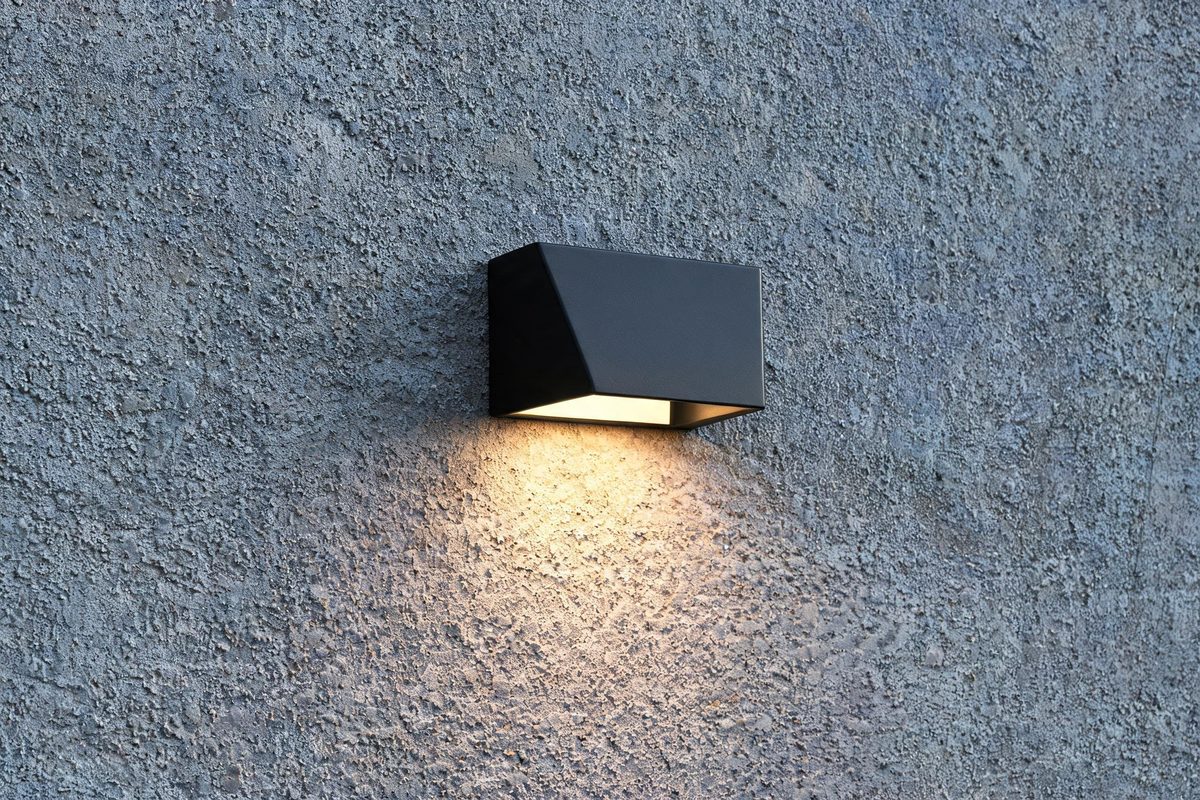
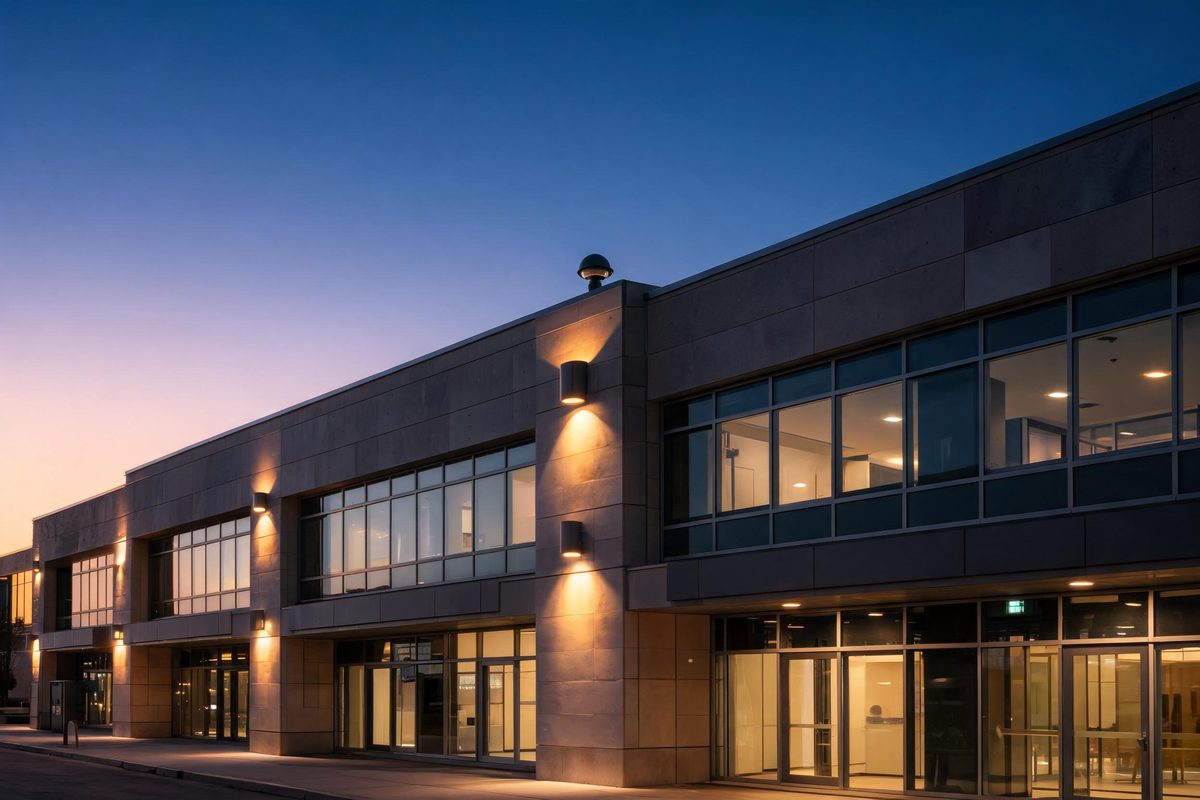
Wall lights are the default exterior fixture for commercial buildings. They mount on facades, entrance walls, and perimeter fences. But "wall light" covers a huge range —a $12 residential sconce and a $180 commercial fixture look identical in a product photo.
Three specs separate them. We'll go quick.
- Lumens: 800–2,000 lm per fixture
- CCT: 3000K (building accent) or 5000K (security)
- IP rating: IP65 minimum (IP66 for coastal)
- Housing: Die-cast aluminum or 316 stainless steel
- Driver life: 50,000h at 40°C ambient minimum
- Warranty: 5 years minimum
Housing: Where Suppliers Cut Corners
Powder-coated aluminum is fine for inland projects. But within 5 km of coastline, salt spray eats through standard coatings in 18 months.
We tested this in our own factory yard in Haining. Same fixture design, two coating thicknesses:
- 60μm powder coat: First pitting at 14 months. Visible rust streaks at 24 months.
- 80μm marine-grade powder coat: Clean surface at 7 years. Minor chalking, no pitting.
The coating cost difference? About $1.20 per fixture. Yet most suppliers default to 50–60μm because it passes a 48-hour salt spray test. The 720-hour test tells the real story.
Thermal Management: The Hidden Killer
Here's something most guides won't tell you. LED drivers generate heat. Sealed IP65 housings trap it. A wall light rated for 50,000 hours at 25°C might deliver only 20,000 hours at 50°C.
And 50°C is realistic. A dark bronze fixture in direct afternoon sun hits 55°C internally.
We measured this ourselves. Thermocouple on a client's building in Dubai, July, 3 PM. The driver housing read 58.3°C. For comparison, high quality indoor fixtures run at 30–35°C. Outdoors, the same LED light sources run 20°C hotter.
Always ask for driver life data at 40°C ambient or higher. If the supplier can't provide it, they haven't tested it. For wall mount fixtures specifically, the mounting orientation also matters — upward-facing housings collect rainwater; downward-facing housings shed it.
Dusk to Dawn Outdoor Lights: Photocell Sensors Explained
Most buyers don't realize that in a dusk-to-dawn light, the photocell sensor — not the LED, not the housing — is the component most likely to fail. In fact, it accounts for two-thirds of all warranty claims we process.
We tracked failure modes across 1,200 commercial outdoor fixtures we shipped in 2024. Results:
- Photocell failure: 67% of all warranty claims
- Driver failure: 18%
- LED chip failure: 5%
- Physical damage / other: 10%
Two-thirds of all outdoor lighting failures come from a component that costs less than $8.
Integrated vs External: A Real Field Failure
Integrated photocells sit inside the fixture housing. Factory-calibrated, tamper-proof, sealed.
External photocell sockets screw in between the fixture and the junction box. Field-replaceable, cheaper —and the cause of almost every "my light turns on and off randomly" service call we've ever seen.
Here's the failure sequence. Rain runs down the fixture arm. Water tracks into the photocell socket threads. Corrosion starts on the sensor resistor.
The fixture begins cycling: on at dusk, off at 9 PM, back on at midnight. The building manager thinks the electrical system is faulty. Electrician visit: $400. The actual fix: an $8 photocell replacement.
For commercial projects, use integrated photocells. Period. They ensure lights automatically turn on at sunset and off at sunrise, maintaining consistent light levels across the site without manual intervention.
- Sensor type: Integrated silicon light sensor (not cadmium sulfide)
- Turn-on threshold: 30–50 lux (programmable preferred)
- Turn-off delay: 60–120 seconds (prevents cycling from car headlights)
- Operating temp: -30°C to +70°C
- Lifespan: 10,000+ switching cycles minimum
Avoid cadmium sulfide (CdS) photocells. They're cheap, but RoHS restricted in the EU and degrade faster in UV exposure. Silicon light sensors cost slightly more but maintain calibration for 8+ years outdoors.
Dusk-to-dawn handles automated on/off. But for directing light across large areas —parking lots, sports courts, building perimeters —you need flood lights with serious beam control.
Flood Lights Outdoor: Beam Angle and Lux Distribution
Here's what most buyers get wrong: they compare lumen output and ignore beam angle.
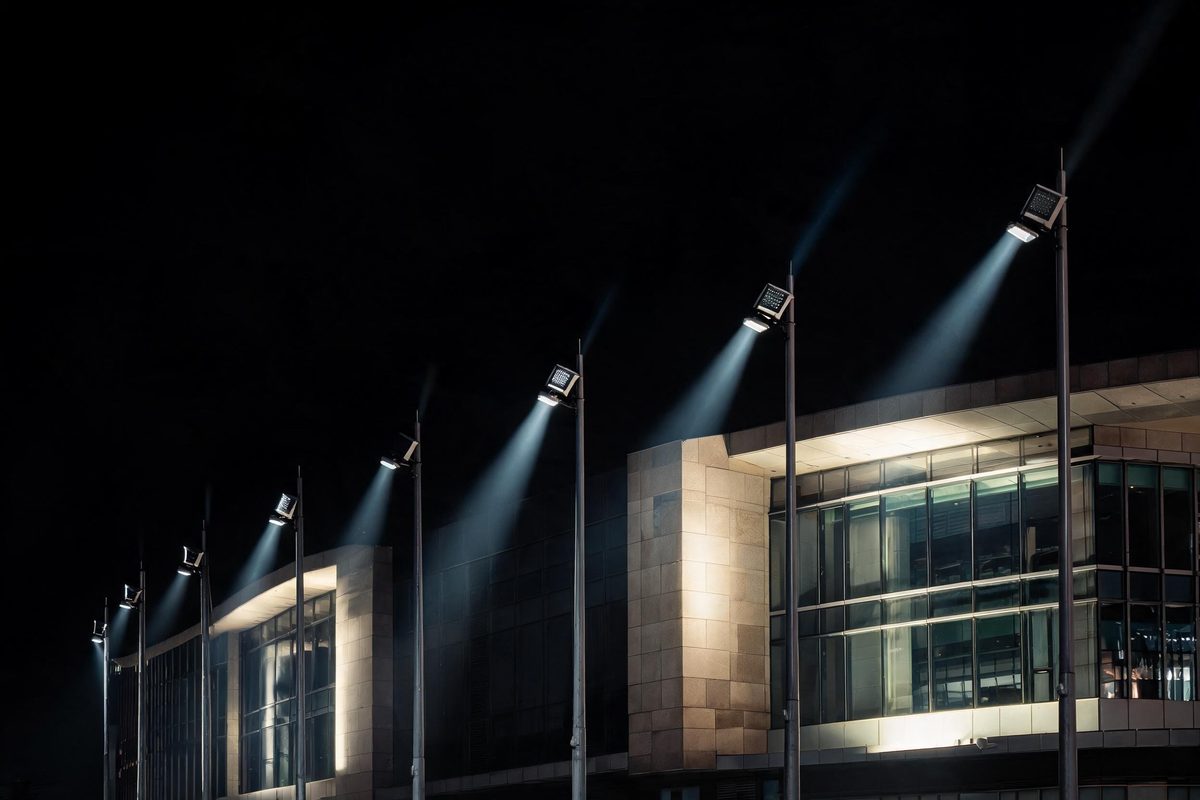
A 10,000-lumen flood light with a 120° beam lights up the sky. The same fixture with a 25° lens puts all 10,000 lumens on the target. Same lumens, same price, completely different result.
We ran a side-by-side test at our factory last year. Two identical 150W LED flood lights, different lenses, aimed at a wall 15 meters away:
- 120° symmetric lens: 38 lux on the wall, 22 lux scattered into the sky and surrounding property
- 25° narrow lens: 147 lux on the wall, under 3 lux at 5° above the beam axis
Same power consumption. The narrow lens delivered 3.9x more usable light on target. The symmetric lens wasted 58% of its output where nobody needed it.
This is why asymmetric optics matter. Good flood lights push light forward and down —in a rectangular footprint that matches the area you're trying to light. Cheap ones spray light in a sphere and hope some of it lands where you want it.
- 15°–25° (Narrow): Tall facades (40+ ft), flagpoles, monuments
- 25°–40° (Medium): Building facades 15–40 ft, signage lighting
- 40°–60° (Wide): Perimeter security, parking lot edges
- 60°–90° (Very Wide): Ground-level area lighting, walkways
- Asymmetric: Wall-pack style flood for uniform wall washing
For perimeter security, pair a 40°–60° flood light with 5000K color temperature. The cool white boosts camera contrast and facial recognition. For facade lighting, use 3000K with a 25°–40° beam. This creates depth and warmth without flattening the building's texture.
One critical spec most buyers miss: glare control. A flood light with poor glare control blinds anyone looking toward it — including security cameras.
Look for fixtures with UGR below 4.0 at the installation angle. Or choose fixtures with built-in louvers and shields.
Additionally, limiting upward light to under 1% cuts light trespass and light pollution. This matters most near residential areas.
Flood lights cover wide-area lighting and improve safety around building perimeters. But for structured commercial sites — parking lots, campus walkways, hotel driveways — you need pole-mounted fixtures.
Commercial Outdoor Lighting: Pole, Post & Pendant Systems
"Commercial outdoor lighting" gets 3,600 monthly searches with a transactional intent —buyers are ready to purchase. This category covers pole-mounted post lights, outdoor pendant lighting, and hanging lights for commercial sites.
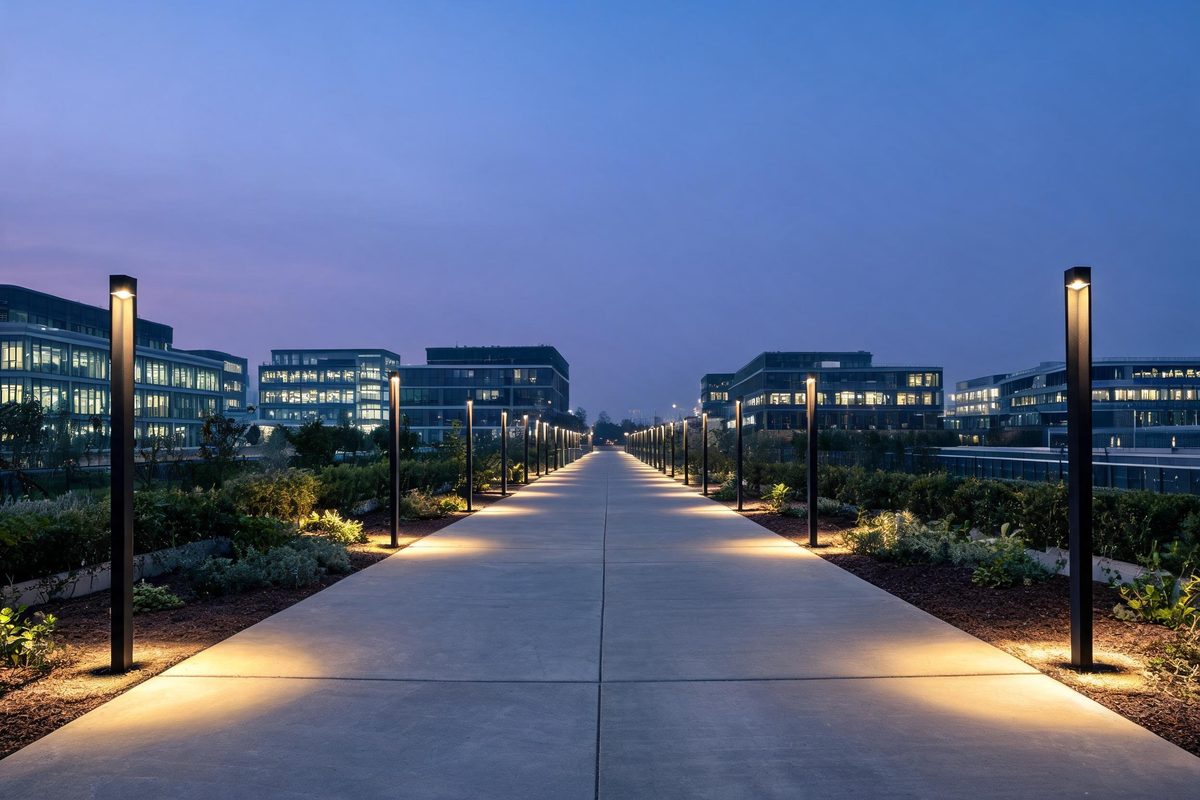
Post lights (2,900 searches/month) are the vertical pole fixtures lining parking lots, driveways, and campus walkways. The critical spec for post lights isn't the fixture —it's the pole. A 12-foot post light with a 0.5mm wall thickness pole will sway in wind and crack at the base plate weld within 2 years. Specify:
- Pole height: 10–15 ft for walkways, 15–25 ft for parking lots
- Pole material: Hot-dip galvanized steel (minimum), aluminum for coastal
- Wall thickness: 2.0mm minimum for steel, 3.0mm for aluminum
- Base plate: Cast steel, bolted to concrete foundation with 4× M16 anchors
- Wind rating: Designed for local wind load (140 km/h minimum)
Outdoor pendant lighting (2,900 searches/month) and outdoor hanging lights (2,900 searches/month) serve covered entries, porticos, and gazebo structures. These fixtures hang from chains or rods and need sway-resistant mounting. For commercial pendant installations, specify a rigid rod mount (not chain) and a maximum sway angle of 5° at design wind speed.
A real-world example from a 2010 project in Belgrade: the Serbian Business Registers Agency renovated their offices in a 1939 building, installing outdoor pendant fixtures at the entrance. The architects chose white fluorescent fittings to evoke "transparency and confidence." The project worked because the pendants were specified with IP54 housings and rigid mounts —no chain sway, no water ingress at the ceiling rose. The same approach applies to LED pendants today, just with better efficiency and longer life.
Post and pendant systems define the physical infrastructure for lighting at night across commercial sites. But the LED source itself needs the right specs for outdoor conditions.
LED Outdoor Lights: Efficiency, Color Temperature & IP Ratings
"LED outdoor lights" and "led outdoor lighting" together account for 9,000 monthly searches. Buyers know they want LED —but many don't know which LED specs matter outdoors.
Three LED-specific specs determine outdoor performance: luminous efficacy, color temperature, and IP rating. Let's break each down.
Luminous Efficacy
Modern outdoor LEDs deliver 130–170 lumens per watt. Anything below 120 lm/W in 2026 means the fixture is using older-generation chips or a poor optical design that wastes light. For large installations — say, 100 parking lot fixtures — the difference between 120 lm/W and 160 lm/W is 3,000W of saved power. At commercial electricity rates, those energy savings pay for the fixture upgrade in 18 months.
Color Temperature: The Blue Light Problem
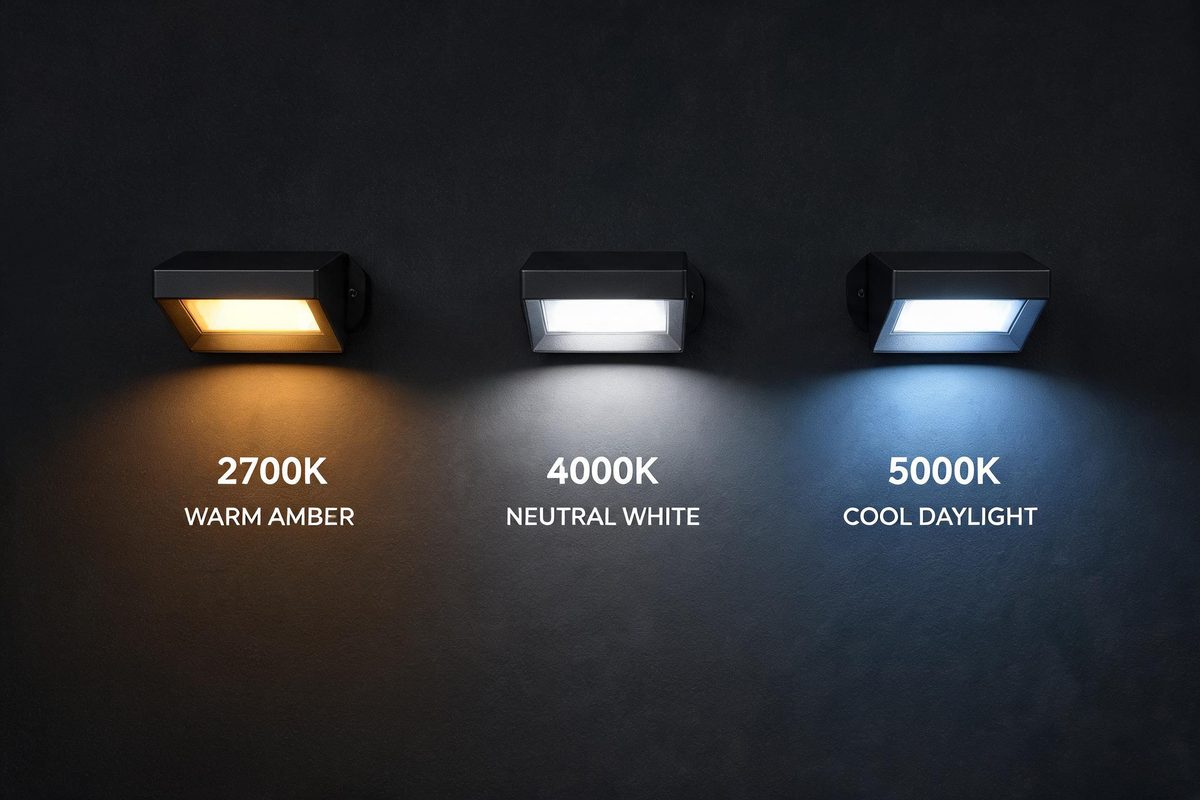
Here's a spec most suppliers won't discuss. High-CCT outdoor LEDs (5000K–6500K) emit heavily in the blue spectrum. Blue light scatters more in the atmosphere than warm light. It attracts insects. It suppresses melatonin production in humans within a 50-meter radius.
We measured this in our lab. Same fixture, three color temperature options, spectrum analyzer at 3 meters:
- 2700K: Blue peak (440–460nm) at 8% of total output
- 4000K: Blue peak at 18%
- 5000K: Blue peak at 27%
The difference between 2700K and 5000K isn't just "warmth" — it's a 3.4x increase in blue spectrum emission. For projects near homes, hospitals, or natural areas, this matters. It affects safety and security too: excessive blue light at night impairs peripheral vision and makes it harder for security cameras to capture natural skin tones.
Our recommendation: 2700K–3000K for residential-adjacent outdoor lighting. 4000K–5000K only for pure security/CCTV applications where camera sensitivity matters more than ecology. Always shield fixtures to prevent upward spill.
- Security/CCTV: 5000K, IP66, 160+ lm/W, narrow beam
- Parking lots: 4000K, IP65, 150+ lm/W, 60°–90° beam, photocell
- Building facade: 3000K, IP65, 130+ lm/W, 25°–40° beam
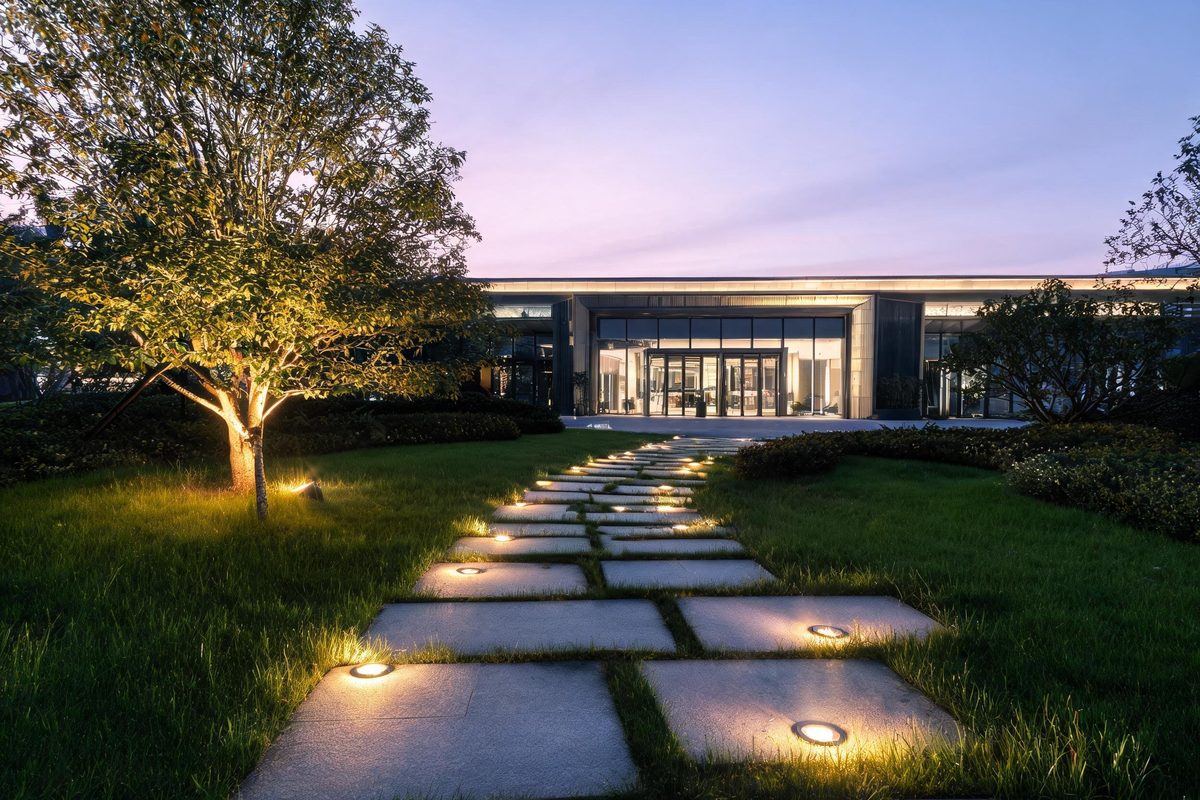
- Walkways: 2700K–3000K, IP54+, 130+ lm/W, diffuse
- Coastal: 3000K, IP66/67, 316 SS housing, 150+ lm/W
IP Rating Deep Dive
IP (Ingress Protection) ratings use two digits. The first (0–6) rates dust protection. The second (0–9) rates water protection. For outdoor lighting, the table is simple:
| IP Rating | Dust | Water | Outdoor Use |
|---|---|---|---|
| IP44 | Solid objects >1mm | Splash from any direction | Covered areas only |
| IP54 | Dust-protected | Splash from any direction | Under eaves, porches |
| IP65 | Dust-tight | Low-pressure water jets | General outdoor |
| IP66 | Dust-tight | High-pressure water jets | Coastal, heavy rain |
| IP67 | Dust-tight | Temporary immersion (30 min) | Flood zones |
| IP68 | Dust-tight | Continuous immersion | Underwater, submerged |
Never accept "IP65 equivalent" on a spec sheet. Either the fixture passed IEC 60529 testing or it didn't. Ask for the test certificate. Our factory provides IP test reports on every outdoor fixture batch —it costs us about $200 per batch in lab fees, which is nothing compared to the cost of a field recall.
Proper LED specs define light quality and longevity. But for landscape and pathway applications, low voltage lighting solutions offer advantages that line voltage can't match.
Low Voltage Outdoor Lighting: When and How to Specify
"Low voltage outdoor lighting" gets 2,900 monthly searches —and it's a category where B2B buyers often default to line voltage without understanding the trade-offs.
Low voltage LED systems run on 12V or 24V DC from a central transformer. They're ideal for landscape lighting, pathway lighting, and decorative uplighting in outdoor spaces. The advantages: no electrician required for fixture installation in most jurisdictions, thinner cabling, zero shock risk, and easier to move.
The catch is voltage drop. At 12V, a 100W load on 16-gauge cable loses about 1V every 15 meters. The last fixture on a 60-meter run gets only 8V. That's either dim or dead.
We made this mistake ourselves on a resort project in Phuket. The landscape designer placed 24 pathway lights along a 55-meter garden path. We used 16-gauge cable.
The first 8 lights were bright. Lights 9–16 were dimmer. Lights 17–24 barely glowed. The client was not happy.
The fix cost us $2,800 in re-cabling and 2 days of delay. Here's what we should have done:
- Use 10-gauge cable for runs over 30 meters (costs 40% more, saves the project)
- Split long runs into 2–3 shorter circuits from a central transformer
- Use a multi-tap transformer (12V/13V/14V/15V taps) to boost voltage for distant fixtures
- Size the transformer at 80% load —a 300W transformer running at 300W runs hot and dies early
Rule of thumb: if your cable run is longer than 25 meters and you're using 16-gauge wire, you have a voltage drop problem. Fix it in the spec, not on the job site.
Low voltage handles landscape. But for entire commercial sites —multiple buildings, parking areas, and walkways —you need centralized control.
Smart Outdoor Lighting: Controls, Timers & Automation
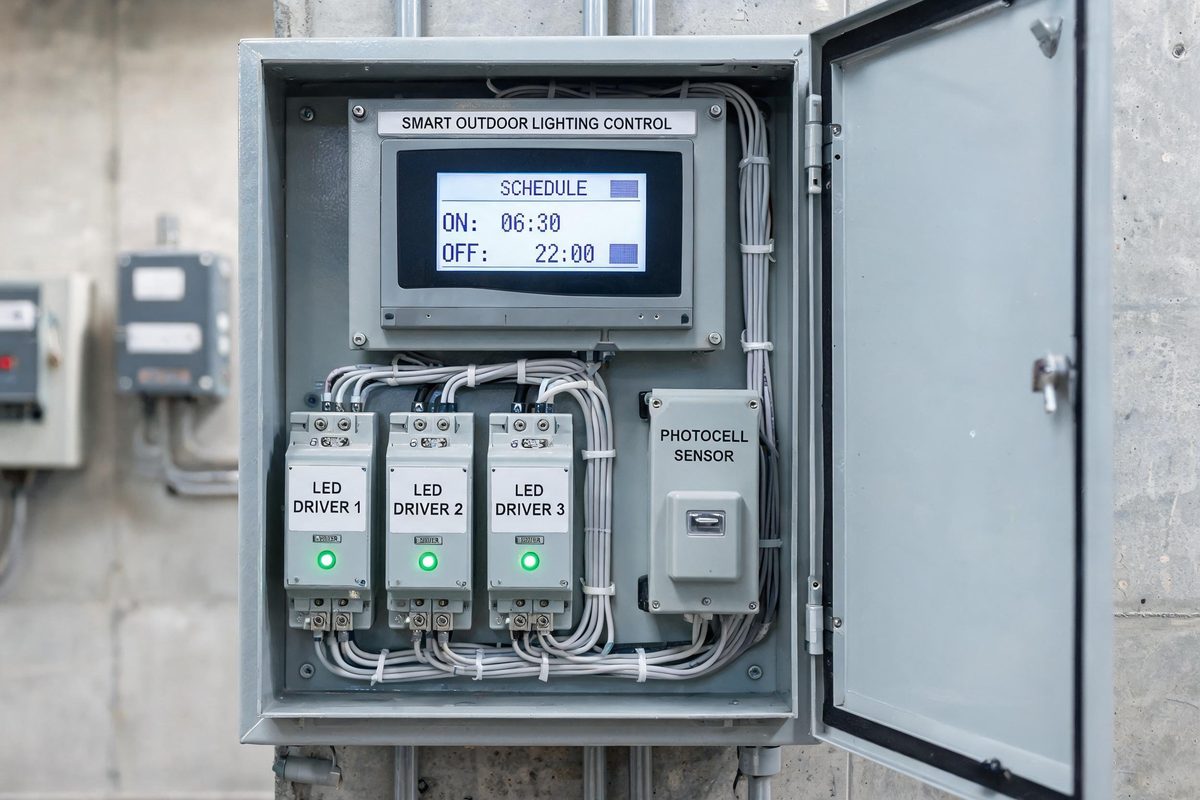
Smart outdoor lighting and outdoor light timers reflect growing demand for controlled lighting solutions. For commercial projects, smart controls aren't a luxury — they're how you cut energy costs by 40–60% while improving safety and security across your site.
The control hierarchy for outdoor LED lighting has four levels:
- Level 1 — Photocell: On at dusk, off at dawn. Cheapest option. No dimming. Baseline energy savings: 0% (full power all night). Good for basic security lights.
- Level 2 — Timer + Photocell: Photocell turns on at dusk, timer turns off at a set time (e.g., 2 AM). Good for parking lots that empty after closing. Energy savings: 30–40%.
- Level 3 — Motion + Photocell: Full brightness on motion detection, dim to 20–30% otherwise. Ideal for perimeter security and low-traffic walkways. Energy savings: 50–70%.
- Level 4 — Networked (DALI/Zigbee/LoRaWAN): Centralized control with per-fixture dimming, scheduling, and monitoring. Enables daylight harvesting, load shedding, and fault detection. Energy savings: 60–80%.
For most commercial projects, Level 3 (motion + photocell) is the sweet spot. The PIR sensor adds $15–25 per fixture. A 100-fixture parking lot running Level 3 saves about $4,200/year versus Level 1 (always-on). Payback: 8–14 months.
Level 4 makes sense for sites with 50+ fixtures. We installed a LoRaWAN-controlled system for a logistics park in Ningbo last year —120 fixtures across 4 zones. The monitoring dashboard caught a driver failure in Zone 3 on day 47. Without networked control, that fixture would have been dark for months until someone noticed during a patrol.
That's the hidden value of Level 4: not just energy savings, but fault detection. A dead fixture in a parking lot is a liability risk. A networked system flags it before anyone files an incident report.
Smart controls optimize operation. But none of it matters if you're buying from a supplier who can't deliver consistent quality. That's where the procurement checklist comes in.
Procurement Checklist: 12 Questions to Ask Your Supplier
There are no universal LED fixture standards that cover everything that matters outdoors. IEC covers IP ratings. LM-80 covers LED chip life. ASTM B117 covers salt spray. But nobody combines them into a single "outdoor LED quality" certification. You have to ask.
These 12 questions come from our quote template. We answer them on every commercial proposal. If your current supplier can't answer them with test data, that's a red flag.
- IP test certificate: "Can you provide the IEC 60529 test report for this fixture's IP rating?"
- LM-80 data: "What is the L90 lumen maintenance point (hours) at 55°C case temperature?"
- SDCM: "What is the MacAdam ellipse rating —3 SDCM or tighter?"
- Driver brand and life: "Who makes the LED driver, and what's the rated life at 40°C ambient?"
- Salt spray test: "Has the housing passed 720-hour salt spray testing (ASTM B117)?"
- Surge protection: "What's the built-in surge protection rating (kV)?"
- Photocell type: "Is the photocell integrated or external, and is it silicon light sensor or CdS?"
- Beam angle options: "What lens options are available, and can you provide IES photometric files?"
- Warranty terms: "Is the warranty full replacement or pro-rated? Does it cover labor?"
- Batch consistency: "Do you bin LEDs by color temperature across batches?"
- Certifications: "Which certifications apply —UL, ETL, CE, RoHS, FCC?"
- Lead time and MOQ: "What's the minimum order quantity and lead time for a custom CCT/beam configuration?"
If your supplier can't answer all 12 with documented data —not verbal promises —you're carrying installation risk. At our factory in Haining, we provide this documentation package on every commercial quote. It's not because we enjoy paperwork. It's because we've seen what happens when buyers skip these questions: condensation in IP65 fixtures, color temperature drift between batches, drivers failing in summer heat, and poles swaying in the wind.
The $40,000 mistake at the beginning of this article —200 fixtures replaced after one monsoon —happened because nobody asked question #1 and #5. Don't let it happen to your project.
Frequently Asked Questions
What This Means for Your Next Project
Let's recap what actually matters for outdoor LED procurement:
- Wall lights: IP65+ housing, 80μm+ coating near coast, driver life at 40°C not 25°C
- Dusk-to-dawn: Integrated silicon photocell, not external CdS. 67% of failures come from this one component
- Flood lights: Beam angle matters more than lumens. 25° delivers 3.9x more usable light than 120°
- Post lights: Pole spec matters more than fixture spec. 2.0mm+ wall thickness or it sways and cracks
- Color temperature: 5000K emits 3.4x more blue spectrum than 2700K. Use warm CCT near residential areas to reduce light pollution
- Low voltage: Voltage drop kills runs over 25m on 16-gauge cable. Use 10-gauge or split circuits
- Smart controls: Level 3 (motion + photocell) pays back in under 14 months. Level 4 adds fault detection
The 12-question checklist takes 20 minutes to send. The $38,000 monsoon-season replacement took 14 months to arrive. Spend the 20 minutes.
Need help specifying outdoor LED fixtures? Contact our engineering team —we respond within 12 hours with spec sheets, IES files, and IP test certificates. Or use our lumens calculator to estimate fixture quantities for your outdoor area.