Approve the effect before selecting the material
For a hotel, restaurant, or lighting distributor, the shade affects more than the unit price. You also buy a visible finish, a handling requirement, and a replacement item.
Clear, tinted, frosted, and opal finishes can change how a lamp appears through either material. Compare finished samples with the same approved light source and viewing positions.
Do not select glass from a photograph and assume an acrylic alternative will reproduce its appearance. Ask your customer to approve the illuminated sample, surface finish, and acceptable variation before production.
Use a material comparison tied to the job
ACRYLITE’s sheet guidance identifies weight, impact behavior, surface hardness, and chemical resistance as practical differences. Those sheet properties do not establish the performance of a finished lamp shade.
| Order consideration | Glass shade | Acrylic shade |
|---|---|---|
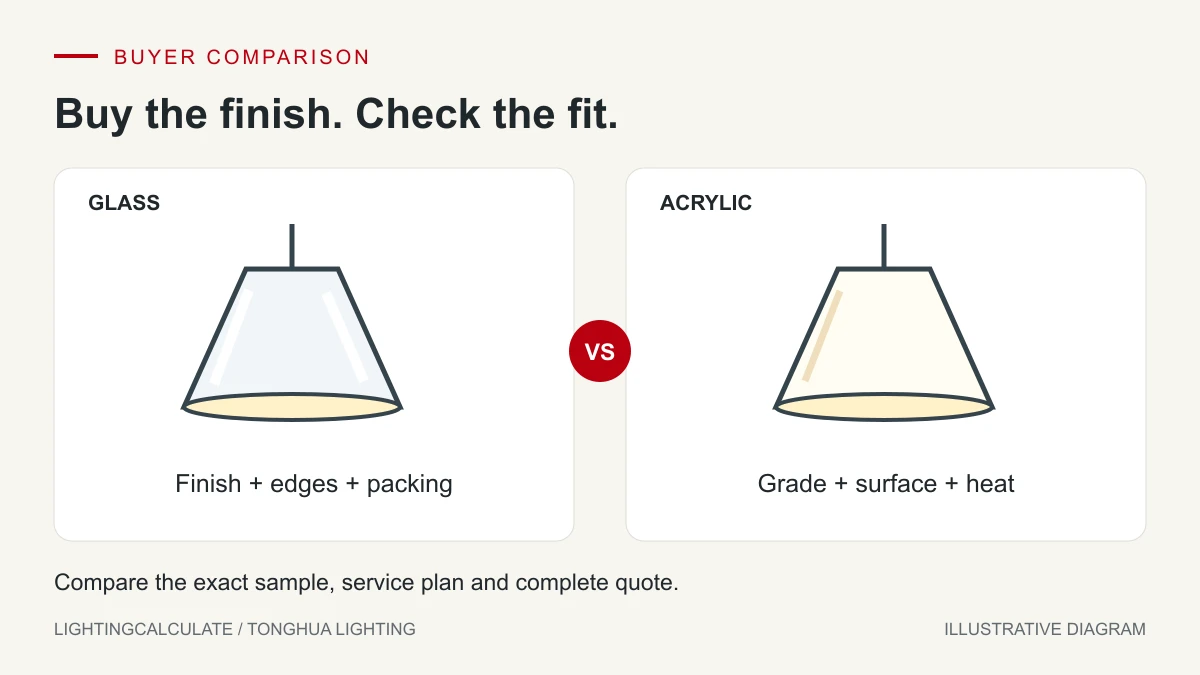
| Appearance | Approve clarity, tint, texture, and visible variation | Approve grade, tint, diffusion, and visible molding marks |
| Weight | Obtain actual shade and complete fitting weights | Obtain actual weights; do not assume a fixed saving |
| Handling | Inspect edges, chips, cracks, and packing support | Inspect cracks, scratches, distortion, and packing support |
| Cleaning | Check compatibility with coatings and decorative finishes | Require cleaner compatibility for the exact grade and finish |
| Heat and assembly | Confirm approved source, clearances, and mounting | Confirm grade temperature limits and complete fitting suitability |
| Replacement | Match opening, neck, height, finish, and attachment | Match those dimensions plus material grade and surface treatment |
| Shipment | Approve packaging and a transit test for your shipping route | Approve packaging; impact tolerance does not prevent surface damage |
Conventional acrylic sheet is more prone to surface scratching than glass, according to the same manufacturer guidance. Ask about the actual surface treatment rather than assuming every acrylic grade behaves identically.
A lighter shade also does not guarantee a lower freight bill. Compare packed carton dimensions, shipment volume, and chargeable weight in both quotations.
Check housekeeping and heat together
Ask your customer which cleaning products their housekeeping team already uses. Have the supplier approve the cleaning method for the material, coating, and decorative finish.
Many glass cleaners are unsuitable for acrylic, while decorated glass can also have finish restrictions. Give your maintenance team written instructions instead of relying on the material name.
Acrylic is a combustible thermoplastic, so do not substitute it into a fitting approved for a different shade. Confirm the exact grade, light source, clearances, and complete product’s applicable safety documentation.
Do not assume glass alone makes a complete fitting heat-safe. Use the manufacturer’s source restrictions and installation instructions for either option.
We recommend reviewing the LED heat and enclosure checklist alongside the approved sample. That connects your material decision with the fixture’s actual operating conditions.
Agree on packing and acceptance before shipment
A low quoted price loses value when shades arrive damaged or cannot fit the supplied holders. Define acceptance criteria while you can still change the packing and production instructions.
- Identify the material grade, finish, dimensions, and approved reference sample.
- Define acceptable visible defects, viewing conditions, and dimensional tolerances in writing.
- Check the shade opening and attachment against the actual holder.
- Review individual protection, separators, movement inside cartons, and outer carton strength.
- Agree on a transit test suited to your carrier and shipping route.
- Specify inspection records, damage reporting, replacement terms, and responsibility for freight.
Include an assembly check with the approved holder and fasteners. A replacement shade with the right diameter can still have an incompatible neck or attachment.
Compare landed cost per accepted shade
Use the same delivery terms and acceptance criteria when comparing supplier quotes. Then calculate how many usable shades your landed spend actually provides.
The following example compares two hypothetical shade-only orders of 100 units. The assumed rejection counts illustrate the calculation; they are not glass or acrylic damage-rate forecasts.
| Assumed input | Glass option | Acrylic option |
|---|---|---|
| Order quantity | 100 shades | 100 shades |
| Unit price | $42 | $39 |
| Total freight and other landed charges | $300 | $240 |
| Landed spend | 100 × $42 + $300 = $4,500 | 100 × $39 + $240 = $4,140 |
| Rejected or unusable shades | 4 | 1 |
| Accepted shades | 96 | 99 |
| Landed cost per accepted shade | $4,500 ÷ 96 ≈ $46.88 | $4,140 ÷ 99 ≈ $41.82 |
Neither example delivers all 100 usable shades required by the project. Add the cost and timing of replacements before deciding which quote meets the opening schedule.
For your order, replace every input with the agreed quotation and a documented acceptance scenario. Include duties, taxes, claims, spare units, and replacement freight according to your actual commercial terms.
The lower calculated cost is only one purchasing criterion. You still need the approved appearance, safe assembly, cleaning compatibility, and an available replacement specification.
Buy a repeatable specification, not a material label
For repeat hotel rooms or restaurant sites, keep an approved physical shade with your purchasing record. Record material, grade where applicable, finish, dimensions, attachment, and the matching light source.
Ask the supplier to confirm spare shade availability, minimum quantities, and replacement lead times. Require written approval before any material, coating, or tooling change affects a repeat order.
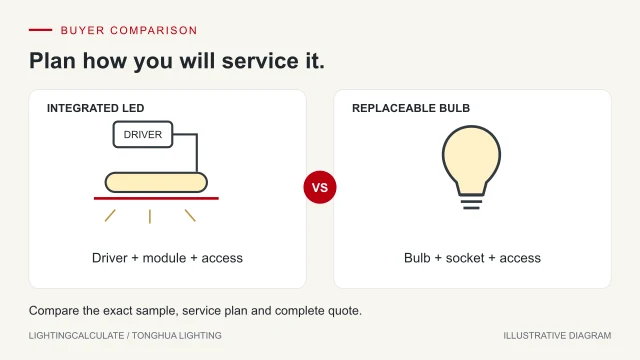
Shortlist the design on our pendant product page, then confirm the shade specification for that model. For maintenance planning, also compare integrated LED and replaceable bulb fixtures.
Questions before ordering
Is acrylic always cheaper than glass?
Material alone does not determine your landed cost. Compare finished quotes, packing, chargeable freight, accepted quantities, and replacement terms.
Can I replace a glass shade with acrylic?
Do not substitute materials based only on matching dimensions. Ask the fixture manufacturer to approve material, heat conditions, attachment, and the complete assembly.
Which material is best for hotel or restaurant orders?
Start with the approved appearance and your operating requirements. Then compare handling, cleaning, complete fitting suitability, spare availability, and usable-unit cost.
References and scope
- ACRYLITE: acrylic sheet vs glass, properties and substitution considerations
- ACRYLITE: care, cleaning, and storage guidance
These references describe acrylic sheet rather than certify a finished lighting product. Use the selected shade’s documentation and approved sample for your purchase decision.